
100+ peer-reviewed
Studies referenced
WHO · EFSA · IARC · FDA
Regulatory framework
Diners & kitchen workers
Populations covered
Four senior researchers
Disciplines reviewed
A paradox that almost no one talks about and that operators with health-conscious customers, ESG commitments, or institutional contracts cannot afford to ignore.
World Health Organization
17.9M
The WHO links a significant share of global cardiovascular mortality to dietary factors. Industrial trans fats and degraded cooking oils are specifically targeted for global reduction under the WHO REPLACE framework.
World Health Organization · 2024
1 in 5
WHO data indicates one in five people will develop cancer. Environmental and dietary exposures including acrylamide and PAHs are among the contributing factors.
IARC · International Agency for Research on Cancer
Group 2A
Acrylamide, a compound formed during high-temperature frying of starchy foods, is classified by IARC as probably carcinogenic to humans. The classification underpins regulatory benchmarks across the European Union and FDA guidance in the United States.
European Food Safety Authority
EFSA
EFSA's CONTAM Panel has set the regulatory direction for the European market: foodservice operators handling fried products are expected to adopt mitigation measures and meet benchmark levels under Commission Regulation 2017/2158.
The international literature describes two distinct exposure pathways from repeatedly heated frying oil: through the food itself, and through the air it releases. Both inform why operators are now expected to manage frying oil to a measurable standard.
Population 01
Schools, Restaurants, Hotels, Supermarkets, Hospitals, Catering, Institutional Foodservice.
Repeatedly heated oil creates degradation compounds that become part of fried food.
Epidemiological studies report odds ratios up to 2.6× with frequent consumption of well-done fried meats, with heterocyclic amines (HCAs) and PAHs identified as the documented mediators.
Published Epidemiology · Fried-Meat Consumption Cohorts
Multiple population studies report risk increases on the order of +52% in populations with high consumption of fried foods, with degradation byproducts identified as a contributing dietary factor.
Published Epidemiology · Multi-Cohort Meta-Analysis
Published research documents elevated pancreatic cancer risk in men (up to +50%) and an esophageal odds ratio of 1.44× in populations consuming commercially fried foods at high frequency.
Dietary Epidemiology · Published Cohorts
Per the World Health Organization, trans-isomer fatty acids and oxidized lipids accumulating in repeatedly heated oils are targeted for global reduction. CVD remains the leading global cause of mortality at 17.9M deaths per year.
WHO Global Health Observatory · REPLACE Initiative
Population 02
QSR Kitchens, Hotel Kitchens, Catering Operations, Institutional Foodservice, Industrial Frying.
Cooking fumes contain airborne degradation compounds released from frying oil.
Multi-cohort studies in environmental science journals report substantially elevated lung cancer odds ratios in kitchen workers with sustained moderate-to-high exposure to frying fumes.
Environmental Sci. & Pollution Res. · Multi-Cohort
Occupational medicine literature documents direct, measurable short-term reductions in lung function in kitchen staff after exposure to cooking fumes during active service.
J. Occupational Medicine & Toxicology · 2009
Public health literature documents significantly elevated incidence of chronic bronchitis among non-smoking kitchen workers chronically exposed to cooking oil fumes, particularly among women.
BMC Public Health · 2018
The International Agency for Research on Cancer classifies multiple PAHs as Group 1 or 2A. These compounds and toxic aldehydes are documented in deep-frying emissions and indoor kitchen air.
IARC Monographs · Multiple Entries
A paradox that almost no one talks about and that operators with health-conscious customers, ESG commitments, or institutional contracts cannot afford to ignore.
C–C–C–COOH
Total Polar Materials
The international benchmark for frying oil quality. Polar materials accumulate as oil oxidizes. Most European jurisdictions cap usable oil between 24% and 27% TPM, enforced through inspection.
EU Member-State Regulatory Ceiling
R–COOH
Free Fatty Acids
Released as triglycerides hydrolyze under heat and moisture. Drives off-flavors, lowers smoke point, and signals advanced oil breakdown to inspectors and operators alike.
AOCS Standard Parameter
C3H5NO
Heat-induced byproduct
Forms when reducing sugars react with asparagine at frying temperatures. Classified by IARC as Group 2A and benchmarked under EU regulation 2017/2158 across European foodservice.
IARC 2A · EU 2017/2158 · FDA Guidance
PAH
Polycyclic Aromatic Hydrocarbons
Heavy ring structures forming under prolonged thermal stress. Found in degraded oil and in airborne fumes above active fryers, an operational concern for kitchen air quality.
Multiple IARC Group 1 & 2A Entries
TRANS
Trans-isomer fatty acids
Trans-isomers form during high-temperature processing of unsaturated oils. Restricted or banned in most major markets under the WHO REPLACE framework and FDA, EU, and Canadian regulations.
WHO REPLACE · FDA · EU 2% Cap
R–CHO
Anisidine-detected aldehydes
Volatile carbonyl compounds. The molecular signature of rancid frying oil, and the reason fried products begin to taste of the fryer rather than the food. Tracked via Anisidine Value.
AOCS Cd 18-90 Method
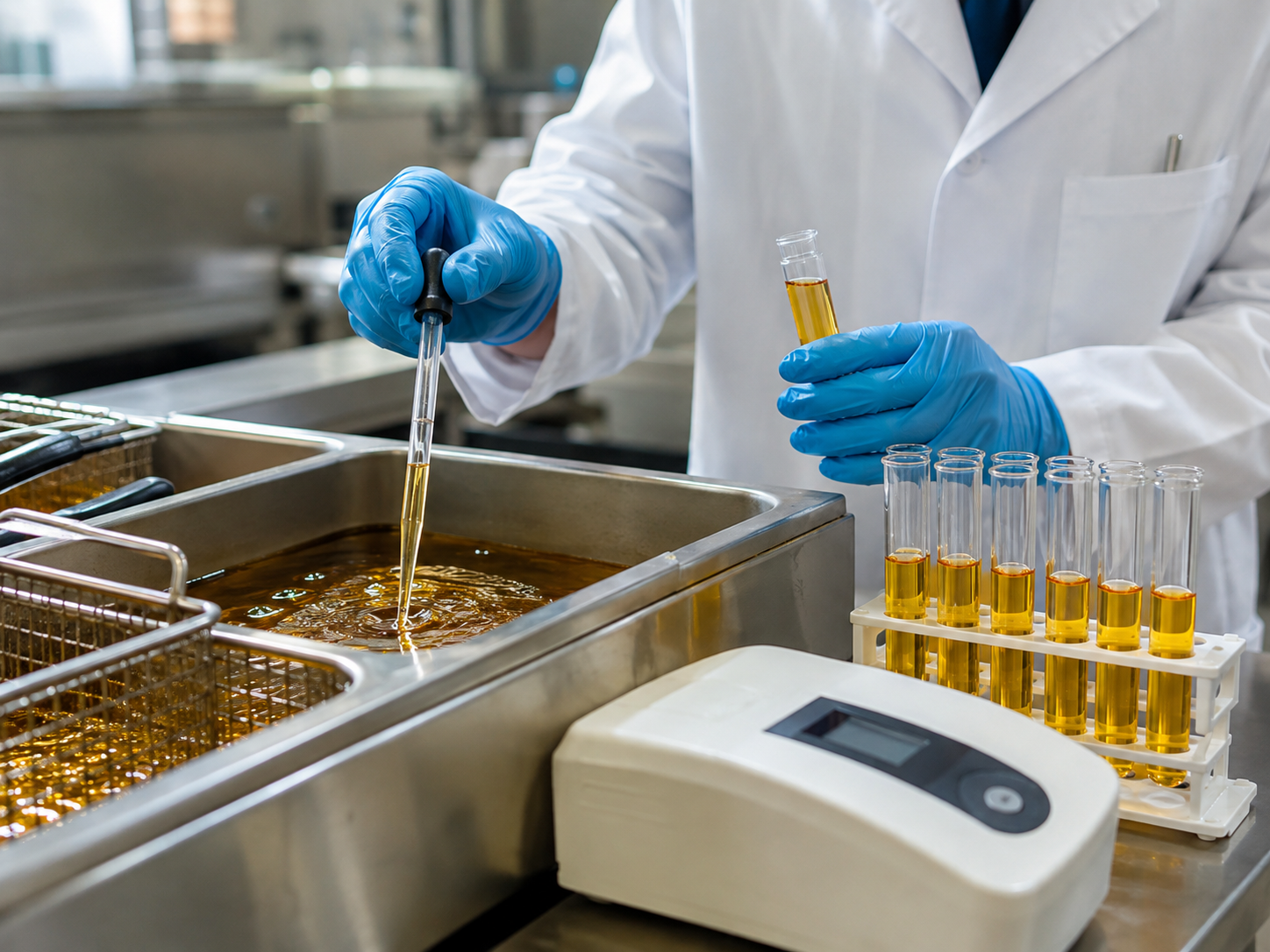
The international literature on repeatedly heated frying oil spans multiple disciplines: food safety chemistry, occupational medicine, and emerging analytic toxicology. This selection below maps directly onto the markers featured on this page.
Theme 01
Env. Sci. & Pollution Res.
Documents the emission of polycyclic aromatic hydrocarbons during deep frying, providing a quantitative baseline for what accumulates in commercial kitchen environments.
Env. Sci. & Pollution Res.
Documents the emission of polycyclic aromatic hydrocarbons during deep frying, providing a quantitative baseline for what accumulates in commercial kitchen environments.
Env. Sci. & Pollution Res.
Documents the emission of polycyclic aromatic hydrocarbons during deep frying, providing a quantitative baseline for what accumulates in commercial kitchen environments.
Env. Sci. & Pollution Res.
Documents the emission of polycyclic aromatic hydrocarbons during deep frying, providing a quantitative baseline for what accumulates in commercial kitchen environments.
Theme 02
Env. Sci. & Pollution Res.
Documents the emission of polycyclic aromatic hydrocarbons during deep frying, providing a quantitative baseline for what accumulates in commercial kitchen environments.
Env. Sci. & Pollution Res.
Documents the emission of polycyclic aromatic hydrocarbons during deep frying, providing a quantitative baseline for what accumulates in commercial kitchen environments.
Env. Sci. & Pollution Res.
Documents the emission of polycyclic aromatic hydrocarbons during deep frying, providing a quantitative baseline for what accumulates in commercial kitchen environments.
Env. Sci. & Pollution Res.
Documents the emission of polycyclic aromatic hydrocarbons during deep frying, providing a quantitative baseline for what accumulates in commercial kitchen environments.
Theme 03
Env. Sci. & Pollution Res.
Documents the emission of polycyclic aromatic hydrocarbons during deep frying, providing a quantitative baseline for what accumulates in commercial kitchen environments.
Env. Sci. & Pollution Res.
Documents the emission of polycyclic aromatic hydrocarbons during deep frying, providing a quantitative baseline for what accumulates in commercial kitchen environments.
Env. Sci. & Pollution Res.
Documents the emission of polycyclic aromatic hydrocarbons during deep frying, providing a quantitative baseline for what accumulates in commercial kitchen environments.
Env. Sci. & Pollution Res.
Documents the emission of polycyclic aromatic hydrocarbons during deep frying, providing a quantitative baseline for what accumulates in commercial kitchen environments.
Senior researchers across lipid chemistry, medical oncology, urology, and pulmonology have reviewed the chemistry described on this page and its implications. Their written opinions are part of our scientific dossier, available to operators, partners, and researchers on request.

Head of Urology Department Bnei Zion Medical Center
by Professor Sarel Halahmi
"I recommend that health authorities worldwide test and adopt Beyond Oil's technology and collaborate on joint studies to make the use of Beyond Oil mandatory in every fryer globally. Implementing these findings and recognizing the need to use Beyond Oil's filter powder as part of a preventive medicine approach will benefit the public and reduce morbidity for millions of p...
The Hebrew University of Jerusalem
by Professor Nissim Garti
"I am confident in concluding that adopting Beyond Oil's innovative solution will enable restaurants, food producers, and other food manufacturers to offer safer and healthier food to their customers, reducing the risk of severe diseases and improving the general health of the population."

Director of the Pulmonary Division of the Wolfson Medical Center
by Oren Fruchte
"Beyond Oil's innovative solution makes a huge contribution to humanity in the medical field, reducing morbidity and mortality from cancers caused by exposure to frying fumes, thereby making a great contribution to improving the general health of the population."

Clinical Professor of Medical Oncology & Radiotherapy
by Professor Ilan Ron
"Regular use of Beyond Oil serves as an effective means to reduce both dietary and occupational exposure to a wide range of carcinogenic substances formed during repeated frying. Therefore, there is reason to consider integrating this technology as a preventive recommendation in high-risk settings — such as schools, hospitals, industrial kitchens — and even promoting public health policies that limit...

Senior researchers across lipid chemistry, medical oncology, urology, and pulmonology have reviewed the chemistry described on this page and its implications. Their written opinions are part of our scientific dossier, available to operators, partners, and researchers on request.
01 · Compliance
EU regulation 2017/2158, TPM ceilings across European member states, FDA acrylamide guidance, and WHO REPLACE trans-fat targets. The regulatory perimeter around frying is expanding. Managing these markers keeps operators measurably inside spec.
Stay ahead of inspection & regulation
02 · Legal
Consumer-side and worker-side exposure to fried-food byproducts is increasingly documented in the literature. A measurable, documented oil-management standard supports an operator's position on duty of care.
A defensible operating standard
03 · Financial
Insurers increasingly price kitchen-related occupational and product-liability exposure into premiums. A documented, certified frying-quality standard supports better underwriting outcomes over time.
Stay ahead of inspection & regulation
04 · Commercial
Quality-conscious consumers, B2B distributors, and institutional buyers increasingly ask how fried product is managed. A measurable oil standard makes quality a visible, certifiable part of the brand promise.
Brand standard · Category leadership
05 · People
EU regulation 2017/2158, TPM ceilings across European member states, FDA acrylamide guidance, and WHO REPLACE trans-fat targets. The regulatory perimeter around frying is expanding. Managing these markers keeps operators measurably inside spec.
Retention · ESG · HSE
06 · Operations
Managing oil chemistry turns frying from a guesswork variable into a measurable, repeatable, scalable operating standard. The same fried product at the first service and the last, the first location and the hundredth.
Measurable · Repeatable · Scalable
The Beyond Oil solution was developed to address the markers documented on this page. Explore the mechanism, the evidence, and the operational outcomes.
Talk to us now